Recycling February 25, 2026 · 8 min read
Appliance and E-Waste Disposal Rules Every Fresno Household Should Know
Four everyday items are legally barred from the ordinary waste stream in California. Knowing which, and why, explains most of what looks like arbitrary pricing.
By Jeremy Bowers, owner of Fresno Junk Haulers
Four categories of everyday household item are legally barred from the ordinary waste stream in California. If you have ever wondered why a fridge costs more to remove than a washer, or why an old television costs more than a new one of the same size, this is the explanation — and it covers most of what otherwise looks like arbitrary pricing.
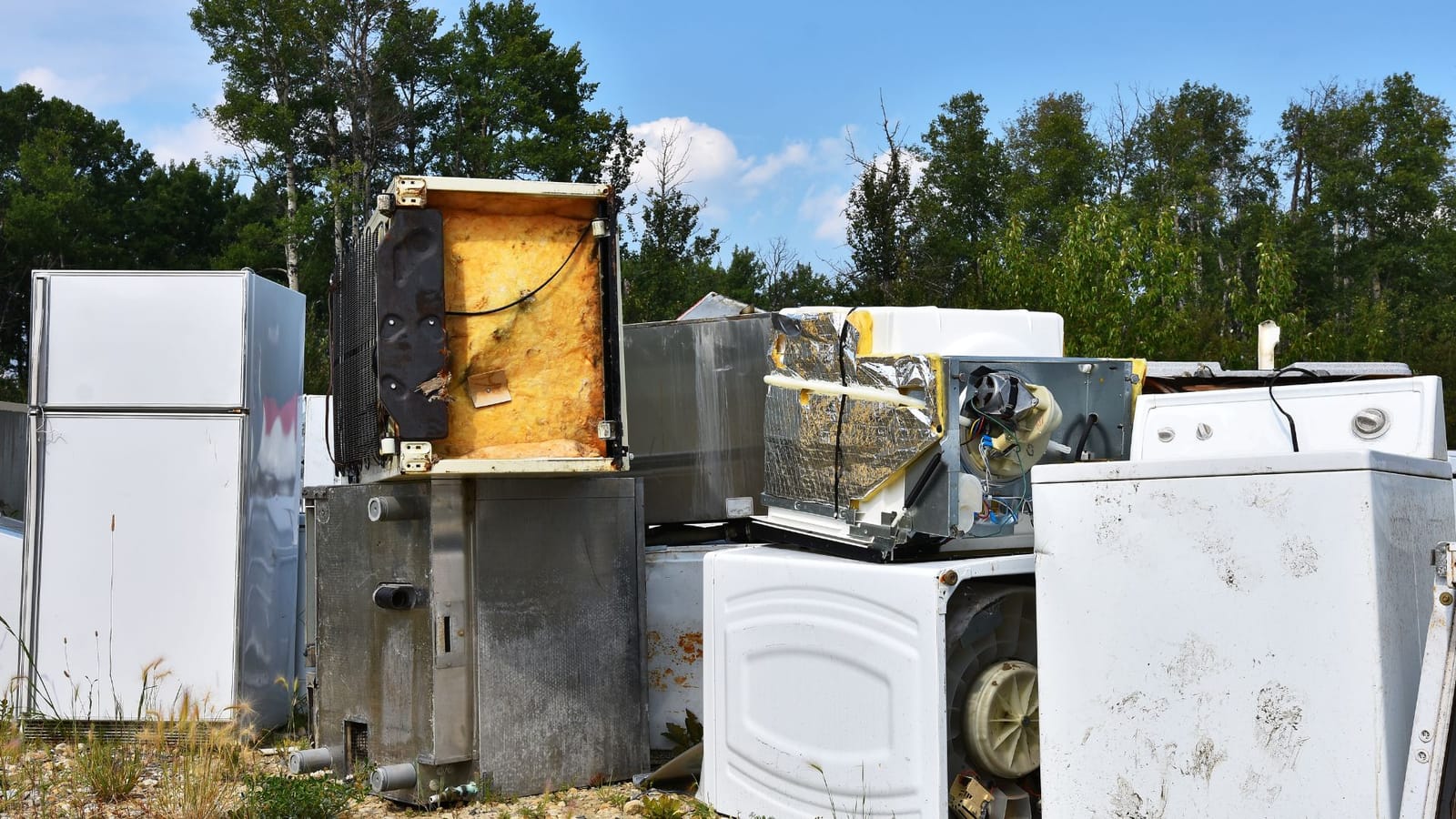
Refrigerant appliances
What it covers: refrigerators, freezers, chest freezers, wine coolers, mini fridges, window and split air conditioning units, dehumidifiers, and commercial refrigeration.
The rule: refrigerant must be recovered by a certified technician before the metal shell can be scrapped. This is not optional and it is not a formality — refrigerants are potent greenhouse gases, and venting them is both illegal and, in older units, genuinely damaging.
What it means for you: a fridge costs more to dispose of than a washer of similar size. Around Fresno, expect $110 to $185 for a refrigerator against $85 to $145 for a washer or dryer. That difference is the recovery, not a markup.
The warning sign: a quote dramatically below everyone else’s on a fridge. That saving has to come from somewhere, and the only place it can come from is skipping the recovery — which means either venting the refrigerant or leaving the unit somewhere it should not be.
Electronic waste
What it covers: anything with a screen or a circuit board. Televisions, monitors, computers, laptops, tablets, printers, copiers, phones, games consoles, stereo equipment, servers, network gear.
The rule: e-waste is excluded from ordinary landfill and must go to a certified recycler. Components include lead, mercury and cadmium, and CRT televisions in particular contain several pounds of leaded glass in the tube.
What it means for you: a flat-screen TV or monitor runs $40 to $75. An old CRT runs $60 to $110, because it weighs three to five times as much and the leaded glass costs more to process. A 32-inch CRT is genuinely a two-person lift.
The bit people forget: the data. A factory reset does not reliably remove what is on a drive. If a machine held anything sensitive — and any business machine did — ask for it to be routed to a recycler that documents drive destruction and issues a certificate. It is available on request and it is what most compliance policies actually require, as opposed to what people assume they require.
Mattresses
What it covers: mattresses and box springs of every size, including futon and sofa-bed mattresses.
The rule: California runs a statewide mattress recycling program funded by a per-unit fee. Mattresses go to a facility that dismantles them rather than to landfill.
What it means for you: a per-unit charge that transfer stations bill separately from general waste, which is why a mattress costs more than its bulk suggests. Around Fresno a single mattress runs $75 to $120 and a mattress-and-box-spring set $95 to $160, with the fee included in the quote.
What actually happens to it: the steel springs go to a metal recycler, the foam is reprocessed into carpet underlay, the fiber becomes industrial felt, and the box spring timber is chipped. Roughly three quarters of a typical mattress is recoverable, which is the entire point of the program.
Tires
What it covers: car, truck and light commercial tires, with or without rims.
The rule: banned from ordinary landfill in California. They must go to a dedicated processor.
What it means for you: priced per tire rather than by volume — $12 to $25 each around Fresno, with rims adding slightly. Bulk lots from a shop clear-out or a project are priced as a load, which works out cheaper per tire.
The genuinely hazardous list
Separate from all of the above, some material cannot go in any truck at all. No legitimate hauler in California will take:
- Paint, stain, solvents and thinners
- Pesticides, herbicides, fertiliser and pool chemicals
- Motor oil, antifreeze, brake fluid and fuel
- Propane tanks and other pressurised cylinders
- Car batteries and loose lithium packs
- Medical sharps and biohazard waste
- Ammunition, flares and fireworks
These go to a household hazardous waste facility. Each county here handles it differently: Fresno County runs free drop-off for residents, Madera County handles it at Fairmead Landfill in Chowchilla, and Kings and Tulare each run their own programs. If you are clearing a garage you will find several items on this list, so plan a separate trip for them rather than discovering it on the day.
Why any of this matters to you
Two practical reasons.
It explains the pricing. Once you know that a fridge carries a certified recovery cost, a CRT carries leaded glass, a mattress carries a state fee and a tire carries a processor charge, the price list stops looking arbitrary. Those costs are real and they are paid at the receiving end whether a hauler mentions them or not.
It tells you who to hire. Every one of these rules costs money to follow. A quote well below everyone else’s on exactly these items is a quote that has found a way around one of them, and the ways around them are all either illegal dumping or improper disposal.
The question that sorts this out takes five seconds: which facility does this go to? A legitimate operator answers immediately and can produce a receipt. Given how many dumped appliances turn up on county roads around Fresno every year, it is worth asking.
Every figure above is a typical range for the Fresno area, not a quote. Prices may vary depending on the condition of the item. Call for a firm number on your actual load.
Need this done rather than read about?
Free on-site estimate, flat price agreed before anything is lifted, and the area swept before we leave. Same-day slots are available most weeks.
Areas this applies to
Quick answers
Are there free e-waste drop-off options in Fresno?
There are, and if you have one small item and a spare afternoon they are worth using. What they do not do is come to your house, carry a hundred-pound CRT down a hallway, or take twenty monitors at once. Free options exist — a collection service is for the carrying and the volume, not because they do not.
What if the appliance still works?
Say so, and it should not be scrapped. Working washers, dryers, fridges and ranges are genuinely useful to household appliance programs and can go to a donation center instead. From the outside a working unit and a dead one look identical, so it has to be mentioned before it goes on the truck.